BAY-179
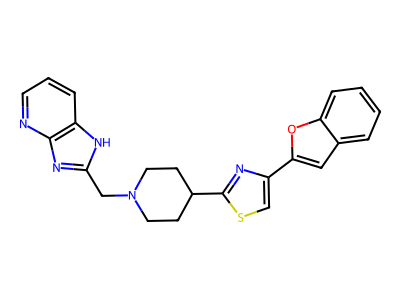
| Target | Complex I quinone binding site (NDUFS2) |
| Targeted domain | Quinone binding site (MT-ND1, NDUFS2/7) |
| Mode of action | Inhibitor |
| Control | BAY-070 |
| Recommended cellular usage concentration | 0.1 - 1 µM |
| In vivo use | yes |
| Donated by | Bayer |
Probe criteria
| Inhibitor/agonist potency: goal is < 100 nM (IC50, KD) | Not applicable |
| Selectivity within target family: > 30-fold | Surpasses criterion: Analog of BAY-179 shows selectivity against other complexes of the respiratory chain (Bio-chemical bovine OxPhos activity assay: > 30 µM for Complex 2, 3, 4 and 5). |
| Selectivity outside target family | Surpasses criterion: Eurofins-Cerep GPCR-Panel: Closest off-target at 10 µM is HTR2B (antagonist effect) with 73.5% inhibition. Selectivity > 500 fold against numerous kinases tested.Closest off-targets in the PDSP scan are HTR2B (Ki = 558.19 nM), TMEM97 (Ki = 1118.32 nM), SIGMAR1 (Ki = 1179.84 nM), ADRA2C (Ki = 3499.92 nM) |
| On target cell activity for cell-based targets: goal is < 1 µM IC50/EC50 | Surpasses criterion: Active in cellular mechanistic assay demonstrating cellular target engagement. Proliferation assays: IC50 = 79 nM (H1299 (human lung; Cellular ATP kit HTS)); IC50 = 33 nM (H1299 (human lung; CellTiter-Glo ATP)); |
| Control compound (100 times less potent than the probe) | Surpasses criterion: BAY-070 inactive (IC50 >20 μM) in cellular assay.Off-targets in the PDSP scan are TMEM97 (Ki = 151.89 nM), SIGMAR1 (Ki = 1286.45 nM) and HTR2B (Ki =1582.15 nM) |