JP3000
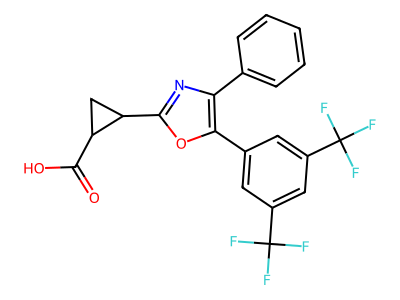
| Target | RXRA RXRB RXRG |
| Targeted domain | Ligand binding domain |
| Mode of action | Agonist |
| Control | JP3001 |
| Recommended cellular usage concentration | 0.1 - 1 µM |
| In vivo use | No |
| Donated by | LMU |
| Developed by Ludwig-Maximilians-University Munich in the Framework of: |

|
Probe criteria
| Inhibitor/agonist potency: goal is < 100 nM (IC50, Kd) | RXRA: Kd < 10 nM (ITC) |
| Selectivity within target family: > 30-fold | Tested on 27 related nuclear receptors at 1 µM (in-house panel): clean (> 100 fold selectivity) |
| Selectivity outside target family | Coming soon |
| On target cell activity for cell-based targets: goal is < 1 µM IC50/EC50 | Hybrid reporter gene assays: RXRA: EC50 = 5 ± 1 nM (38 ± 1-fold), RXRB: EC50 = 1.4 ± 0.4 nM (69 ± 3-fold), RXRG: EC50 = 4 ± 1 nM (24 ± 1-fold)Full-length RXR reporter gene assays: EC50 (RXR:RXR): 2.6 ± 0.3 nM (Homodimer), EC50 (RXR:RAR) = 29 ±2 nM (Heterodimer)GDE1 expression: EC50 ≈ 10 nM (qRT-PCR) |
| Control compound (100 times less potent than the probe) | JP3001: Hybrid reporter gene assays: RXRA: EC50 > 10 µM, RXRB: EC50 > 10 µM, RXRG: EC50 > 10 µM |