A-192621
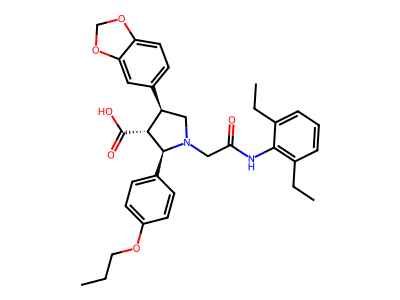
| Target | EDNRB |
| Mode of action | Antagonist |
| Control | A-1806262 |
| Recommended cellular usage concentration | ≤ 300 nM, probe < 1 µM |
| In vivo use | Yes |
| Donated by | Abbvie |
Probe criteria
| Inhibitor/agonist potency: goal is < 100 nM (IC50, Kd) | Surpasses criterion: EDNRB Kd = 8.8 nM (IC50 = 4.5 nM) |
| Selectivity within target family: > 30-fold | Surpasses criterion: EDNRA: Biochemical assay (Inhibition of 125I labeled ET-1 binding to EDNRA) (IC50 = 4.28 µM); Eurofins cellular functional assay - Antagonist (IC50 = 3.6 µM)Clean PDSP scan (43 targets) |
| Selectivity outside target family | Closest off targets: TSPO (72.1%), CCK (63.1%), Cl- channel (77.4%) @ 10 µM |
| On target cell activity for cell-based targets: goal is < 1 µM IC50/EC50 | Surpasses criterion:IC50 = 0.8 nM in EDNRB- dependent phosphatidylinositol hydrolysis assay (> 1 µM in EDNRA- dependent cell assay); Eurofins cellular functional assay (Antagonist): IC50 = 6.5 nM |
| Control compound (100 times less potent than the probe) | The control enantiomer A-1806262 is about 150-fold selective compared to probe: EDNRB (IC50 = 1 µM, Eurofins cellular functional assay - Antagonist); EDNRA (IC50 = 1.6 µM) |