BAY1125976
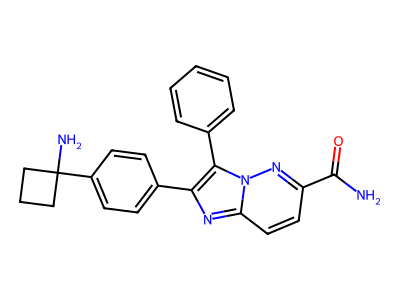
| Target | AKT1 AKT2 AKT3 |
| Targeted domain | Kinase domain (allosteric pocket) |
| Mode of action | Covalent inhibitor (type 4, non-ATP competitive) |
| Control | BAY-940 |
| Orthogonal probe | Borussertib |
| Recommended cellular usage concentration | ≤ 1 µM |
| In vivo use | Yes |
| Donated by | Bayer |
Probe criteria
| Inhibitor/agonist potency: goal is < 100 nM (IC50, Kd) | Surpasses criterion: TR-FRET with full-length protein: AKT1 (IC50 = 5.2 nM at 10 µM ATP and 44 nM at 2 mM ATP); AKT2 (IC50 = 18 nM at 10 µM ATP and 36 nM at 2 mM ATP)SPR: active AKT1 (Kd = 2.7 nM); inactive AKT1 (Kd = 1.3 nM)Truncated AKTs lacking the PH domain (TR-FRET): ΔPH-AKT1 (IC50 >20 µM), ΔPH-AKT2 (IC50 >20 µM) AKT3: IC50 = 427 nM at 10 µM ATP (TR-FRET) (Bioduro) |
| Selectivity within target family: > 30-fold | Millipore KinaseProfilerTM panel (230 kinases at 10 µM): FLT1, FLT3, FLT4 and MERTK > 50 % inhibitionDiscoverX (468 kinases): Kd [nM] (FLT(D835Y) 210), CLK1 (310) and MKNK2 (330) |
| Selectivity outside target family | Ricerca Lead Profiler screen: No effect < 10 µMClean PDSP scan with one off-target: CHRM1 (Ki = 1454.31 nM) |
| On target cell activity for cell-based targets: goal is < 1 µM IC50/EC50 | Surpasses criterion: NanoBRET assay (n=3; SGC Frankfurt): AKT1 (EC50 =15 ± 4.3 nM), AKT2 (EC50 = 30 ± 4.7 nM), AKT3 (EC50 = 200 ± 72 nM)Mechanistic cell assay:
|
| Control compound (100 times less potent than the probe) | BAY-940: NanoBRET assay (n=3; SGC Frankfurt): AKT1 (EC50 = 1300 ± 29 nM), AKT2 (EC50 = 4200 ± 250 nM, AKT3 (EC50 > 50 µM)Biochemical assay: AKT1 (IC50 = 3.74 µM) and AKT2 (IC50 = 3.84 µM) |