BI-1915
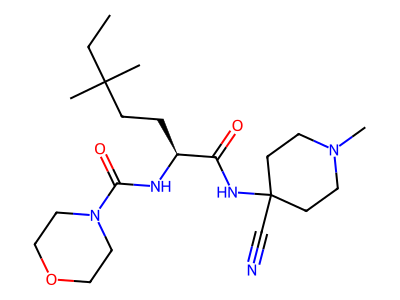
Probe criteria
| Inhibitor/agonist potency: goal is < 100 nM (IC50, Kd) | CTSS binding (SPR): Kd = 31 nM; CTSS inhibition (luminescent based enzymatic assay): IC50 = 17 nM |
| Selectivity within target family: > 30-fold | IC50 [µM]: CTSK ( > 10) , CTSL ( > 30) , CTSB ( > 10)Reaction Biology protease panel (43) at 10 µM: clean, except for papain (87 % inhibition) |
| Selectivity outside target family | Eurofins Cerep SafetyScreen44 at 10 µM: clean |
| On target cell activity for cell-based targets: goal is < 1 µM IC50/EC50 | Antigen challenge cell assay (based on the use of B cells to 'present' exogenous antigen (added ovalbumin) via a cathepsin S dependent process to T cells): IC50 = 2.8 nMEffectively blocks the specific secretion of ovalbumin-induced IL-2 in T-cells. |
| Control compound (100 times less potent than the probe) | BI-1920: CTSS binding (SPR): Kd = 272 nM; CTSS inhibition (luminescent based enzymatic assay): IC50 > 20 µM; Eurofins Cerep SafetyScreen44 at 10 µM: clean |