BI-5121
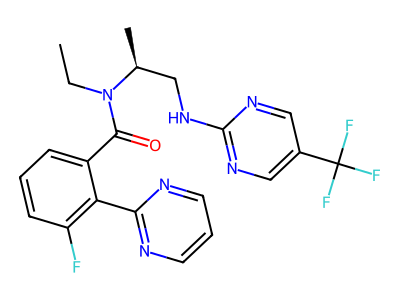
Probe criteria
| Inhibitor/agonist potency: goal is < 100 nM (IC50, KD) | Eurofins radio-displacement assay (HCRTR1 binding): IC50 < 3 nM |
| Selectivity within target family: > 30-fold | Eurofins radio-displacement assay (HCRTR2 binding): IC50 = 140 nM (> 40 fold selectivity), OX2 (HCRTR2) ANTA IP1: IC50 = 62.6 nM (> 39 fold selectivity)GPCR screen (44 targets): clean (OPRK1: IC50 = 730 nM (> 200 fold selectivity)) |
| Selectivity outside target family | Eurofins SafteyScreen (47 targets) at 10 µM: clean |
| On target cell activity for cell-based targets: goal is < 1 µM IC50/EC50 | OX1 (HCRTR1) ANTA IP1: IC50 = 1.6 nM (Functional assay: Activation of the orexin receptors expressed in cell lines results in an increase in intracellular IP3 concentration. IP1, a downstream metabolite of IP3, accumulates in cells following receptor activation and is stable in the presence of LiCl. Using Cisbio™`s HTRF technology with Lumi4TM-Tb cryptate and a suited fluorescence plate reader, this functional response is detectable and quantifiable.) |
| Control compound (100 times less potent than the probe) | BI-6199: Eurofins radio-displacement assay: HCRTR1 binding (IC50 = 2.3 µM), HCRTR2 binding (IC50 > 10 µM), ANTA IP1: OX1 (HCRTR1) (IC50 = 1.1 µM), OX2 (HCRTR2) (IC50 = 8.2 µM); Eurofins SafteyScreen (44 targets) at 10 µM: clean, except for OPRK1 with 44 % inhibition |