JNJ-42226314
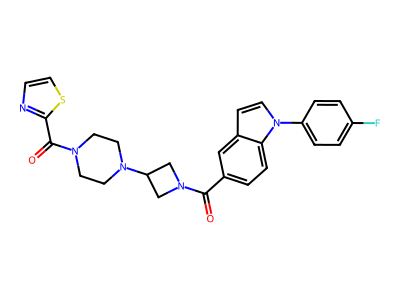
Probe criteria
| Inhibitor/agonist potency: goal is < 100 nM (IC50, Kd) | Surpasses criterion: Fluorometric Assay (Inhibition of 4MU-B cleavage): IC50 < 5 nM (n=10) |
| Selectivity within target family: > 30-fold | Serine protease panel (15 proteases) at 10 µM: cleanPanel of endocannabinoid related targets: Closest hit is hFAAH with IC50 > 4 µM |
| Selectivity outside target family | Kinase Panel: 50 targets, 10 µM ATP at 10 µM, all < 20% inhibitionCEREP panel of 50 binding assays at 10 µM (ion channels, receptors, including CB1 and CB2): binding > 50%: rat OPRK1 (66%), rat HTR1B HTR1B (56%), rat chloride ion channel (55%), human SLC6A3 (54%). Follow up in cellular assays (10 µM): OPRK1 (no activity), HTR1B (inhibition 50%) and inhibited dopamine uptake by 35%.Clean PDSP scan (43 targets at 10 µM). |
| On target cell activity for cell-based targets: goal is < 1 µM IC50/EC50 | Surpasses criterion: [3H] 2-OG cleavage activity assay: IC50 = 1.13 ± 0.05 nM (n> 10, human HeLa cells); IC50 = 1.88 ± 0.41 nM (n = 6, human PBMC); IC50 = 0.67 ± 0.11 nM (n = 9, mouse brain); IC50 = 0.97 ± 0.12 nM (n = 10, rat brain) |
| Control compound (100 times less potent than the probe) | JNJ-8034: Fluorometric Assay (Inhibition of 4MU-B cleavage): IC50 > 10 µM (n=6)Clean PDSP scan (43 targets at 10 µM). |