MRL-650
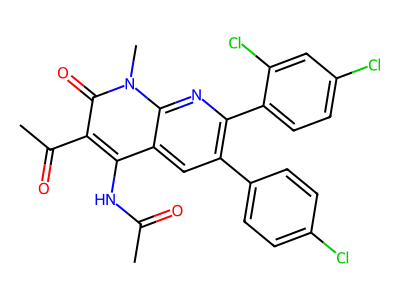
Probe criteria
| Inhibitor/agonist potency: goal is < 100 nM (IC50, Kd) | Both human and rat inverse agonist activity are well below 100 nM. Human CNR1 IC50: 7.5 nM, EC50: 4.9 nM. Rat CNR1 IC50: 22.9 nM, EC50: 4.5 nM. |
| Selectivity within target family: > 30-fold | CNR2 is on the order of 1000-fold less potent with 4.6 µM. Shows off-target activity in the PDSP scan: the closest hits are GABA/PBR (Ki = 82 nM) and TMEM97 (Sigma2 receptor) Ki= 605 nM. |
| Selectivity outside target family | Screened against a customized panel of assorted radioligand binding and enzymatic assays (MDS Pharma Services, Taipei, Taiwan): no inhibition at 10 µM in 152 of 168 assays. All off-targets are > 100-fold less potent. |
| On target cell activity for cell-based targets: goal is < 1 µM IC50/EC50 | In cell functional assay MRL-650 is < 10 nM. |
| Control compound (100 times less potent than the probe) | The control shows 33% inverse agonism at 2 µM and is thus >> 100- fold less potent than the probe itself. Note: Shows off-target activity in the PDSP scan: the closest hits are HTR2C (Ki= 22 nM) and SLC6A3 (Ki= 766 nM) |