SGK3-PROTAC1
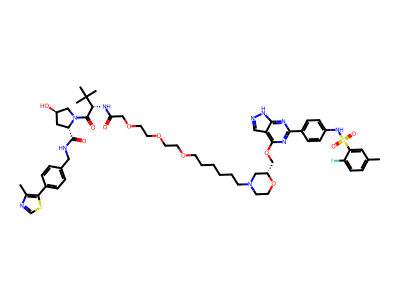
Probe criteria
| Inhibitor/agonist potency: goal is < 100 nM (IC50, Kd) | Surpasses criterion: Biochemical assay: SGK3 IC50 = 300 nM (radioactive filter binding assay using 33P ATP) |
| Selectivity within target family: > 30-fold | Dundee Kinase panel (140 targets) at 1 µM: Closest off-targets are [% activity remaining] SGK1 (34), RPS6KB1 (S6K1) (19); Biochemical assay: RPS6KB1 (IC50 = 1.8 µM), SGK1 (IC50 = 220 nM) |
| Selectivity outside target family | Proteomic analysis of HEK293 cells: clean |
| On target cell activity for cell-based targets: goal is < 1 µM IC50/EC50 | Surpasses criterion: Good degradation: Reduced SGK3 levels by 65% without effecting SGK1, SGK2, or RPS6KB1 at 0.1 µM (HEK293 cells, 48 h)Tested in two SGK3 dependent breast cancer cell lines, CAMA-1 and ZR-75-1: >0.1 μM SGK3-PROTAC1 induced degradation of SGK3, but not SGK1 or RPS6KB1. Blocked mTORC1 activation found in prolonged treatment of cell lines such as CAMA-1 and ZR-75-1 with PI3K or Akt inhibitors and resulted in upregulation of SGK3. |
| Control compound (100 times less potent than the probe) | cisSGK3-PROTAC1: Biochemical assay: IC50 = 600 nM, SGK1 (IC50 = 1.4 µM), S6K1 (IC50 = 1.7 µM); no degradation of SGK3 even at 3 µMDundee Kinase panel (140 targets) at 1 µM: Closest off-target is [% activity remaining] RPS6KB1 (20). |