8RK64
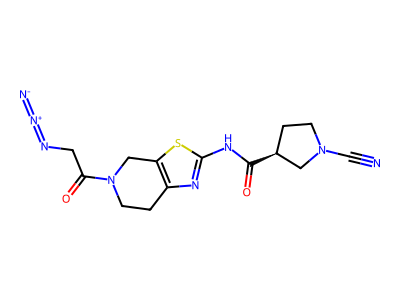

Probe criteria
| Inhibitor/agonist potency: goal is < 100 nM (IC50, Kd) | UCHL1 inhibition assay with Ub-Rho-morpholine as substrate: IC50 = 320 nMKinetic profile: kinact = 0.01382 1/s; KI(app) = 164 µM; kinact/KI = 84 * 1/(M*s) |
| Selectivity within target family: > 30-fold | No inhibition within UCH family: UCHL3 (IC50 = 216 µM); UCHL5 (IC50 >> 200 µM) (Inhibition assay with Ub-Rho-morpholine as substrate)No inhibition of other deubiquitylating enzymes in activity‐based protein profiling assay (ABPP) experiment |
| Selectivity outside target family | 2‐step labelling pull‐down proteomics experiment: One off-target identified in a 2‐step labelling pull‐down proteomics experiment: PARK7 (has a cystein in the active site)PDSP scan clean with one off-target: SIGMAR1 Ki = 3429.51 nM. |
| On target cell activity for cell-based targets: goal is < 1 µM IC50/EC50 | ABPP assay: Full inhibition at a 8RK64 concentration of 3 μM (1h, 37°C). |
| Control compound (100 times less potent than the probe) | JYQ88: UCHL1 inhibition assay with Ub-Rho-morpholine as substrate: IC50 = 12.9 µM (45 times less potent); No UCHL1 inhibition observed in ABPP experiment.Binds much better to PARK7 compared to 8RK64.Clean PDSP scan. |