BAY-826
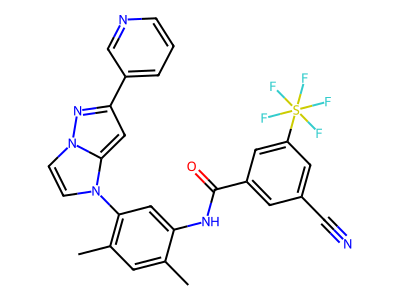
Probe criteria
| Inhibitor/agonist potency: goal is < 100 nM (IC50, Kd) | Surpasses criterion: biochemical assay (TEK (TIE-2)) with IC50 = 0.45 nM; |
| Selectivity within target family: > 30-fold | Surpasses criterion: Selective within the kinome, closest off-targets in cells (NanoBRET data from SGC Frankfurt): STK10 (EC50 = 110 ± 2.1 nM, n= 3), EPHB6 (EC50 = 12 ± 0.97 µM, n= 3), LYN (EC50 = 7.4 ± 0.45 µM, n= 3) |
| Selectivity outside target family | Surpasses criterion: clean LeadProfilingScreen: no inhibition below 1 µMShows off-target activity in the PDSP scan: Closest hits are OPRK1 (Ki = 124.61 nM), GABA/PBR (Ki = 217.26 nM), TMEM97 (Ki = 983.68 nM) and ADRB3 (Ki = 7099.67 nM) |
| On target cell activity for cell-based targets: goal is < 1 µM IC50/EC50 | Surpasses criterion: NanoBRET assay (SGC Frankfurt): TIE1 (EC50 = 11 ± 5.6 nM, n=3), TEK (EC50 = 1.7 ± 0.23 nM, n= 3), DDR1 (EC50 = 1.5 ± 0.22 nM, n=3), DDR2 (EC50= 0.54 ± 0.047 nM, n=3) Cellular mechanistic assay: pTIE2-ELISA, HUVEC-cells with IC50 = 1.3 nM; BAY-826 inhibits DDR1 in cellular kinase assay with single digit nM potency |
| Control compound (100 times less potent than the probe) | Surpasses criterion: BAY-309: > 10,000 times less in biochemical assay (TEK (TIE-2)); >100 times less in cellular assay (DDR1/2, STK10, EPHB6); for Tie-1 is only about 30 fold less potent; NanoBRET assay (SGC Frankfurt): TIE1 (EC50 = 2.6 ± 0.55 µM, n=3), TEK (EC50 = 3.3 ± 0.34 µM, n= 3), DDR1 (EC50 = 200 ± 32 nM, n=3), DDR2 (EC50= 2.7 ± 1.2 µM, n=3), STK10 (EC50 = 3.2 ± 0.44 µM, n= 3), EPHB6 (EC50 =27 ± 5.8 µM, n= 3), LYN (EC50 > 50 µM, n= 3) Shows off-target activity in the PDSP scan: Closest hits are GABAA/PBR (pKi = 8.03) and TMEM97 (Sigma2) (pKi = 6.10). |