BAY-985
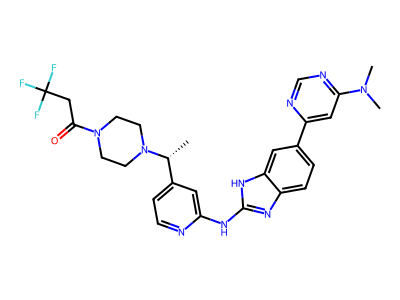
Probe criteria
| Inhibitor/agonist potency: goal is < 100 nM (IC50, Kd>/sub>) | Surpasses criterion: Biochemical assay: TBK1 IC50 = 2 nM (low ATP) and 18 nM (high ATP); IKBKE IC50 = 2 nM (low ATP) |
| Selectivity within target family: > 30-fold | Surpasses criterion: High kinase selectivity for TBK1 and IKBKE (selectivity ratio > 100-fold, except for FLT3 with IC50 = 123 nM (75x) and MAP2K5 IC50 = 847 nM (518x) (both Bayer internal kinase panel); STK17A Kd = 74 nM (49x) and MAP3K19 Kd = 9.6 nM (6x) (both DiscoverX); STK17A IC50 = 310 nM (105x) (Eurofins kinase panel)NanoBRET results ( (SGC Frankfurt): MAP3K19 (EC50 > 50 µM), STK17A (EC50 4.8 ± 2 µM), MAP2K5 (EC50 > 50 µM), FLT3 (EC50 22 ± 3.9 µM) |
| Selectivity outside target family | Clean in Lead Profiling Screen (Eurofins-Panlabs)Two hits in the PDSP scan: TMEM97 (Ki =1155.57 nM) and HTR2B (Ki = 1305.2 nM). |
| On target cell activity for cell-based targets: goal is < 1 µM IC50/EC50 | Surpasses criterion: NanoBRET results (SGC Frankfurt, n= 3): TBK1 EC50 = 48 ± 5.1 nM, IKBKE EC50 = 420 ± 210 nM; Potent cellular mechanistic activity, moderate anti-proliferative activity (SK-MEL-2, IC50 = 900 nM); Minor anti-tumor efficacy in SK-MEL-2 and no activity in MDA-MB-231 xenograft experiments |
| Control compound (100 times less potent than the probe) | BAY-440 > 500-fold less potent than probe in biochemical assays (TBK1: IC50 = 1140 nM (low ATP) and >20 µM (high ATP) and IKBKE: IC50 = 1280 nM (low ATP)); NanoBRET assay (mean, n= 3; SGC Frankfurt): TBK1 (EC50 > 50 µM), IKBKE (EC50 > 50 µM), MAP3K19 (EC50 > 50 µM), STK17A (EC50 > 5.1 ± 2 µM), MAP2K5 (EC50 > 50 µM), FLT3 (EC50 > 50 µM) One hit in the PDSP scan: TMEM97 (Ki =2194.58 nM) |