BI 639667
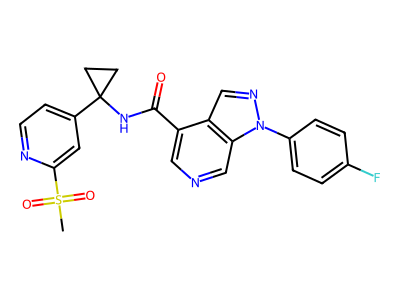
Probe criteria
| Inhibitor/agonist potency: goal is < 100 nM (IC50, Kd) | CCR1 binding affinity, IC50 = 5.4nM (Scintillation Proximity Assay binding) CCR1 molecular potency, IC50= 24nM (Ca2+ flux) |
| Selectivity within target family: > 30-fold | Selectivity over other measured CCRs >1,000-fold. In Cerep panel of CCRs (>90% CTL for: CCR10, CCR9, CCR6, CCR4 @ 10 µm) Clean PDSP scan except for weak activity on ADRB1 (Ki = 1883.65 nM) Eurofins-Panlabs screen at 10 µM: ADORA2A: 69 % inhibition (not reproduced in dose response) |
| Selectivity outside target family | Eurofins-Panlabs receptor screen on 69 targets @ 10 µM: 67 targets < 45 % inhibition, DATRANS 71 % inhibition (not reproduced in dose response) |
| On target cell activity for cell-based targets: goal is < 1 µM IC50/EC50 | CCR1 cellular potency, chemotaxis IC50 = 2.4 nM; Whole blood potency for CCR1 internalization, IC50 = 9 nM |
| Control compound (100 times less potent than the probe) | BI-9307: CCR1 (Ca2+ flux) >3000 nM; Clean PDSP scan |