Huib32
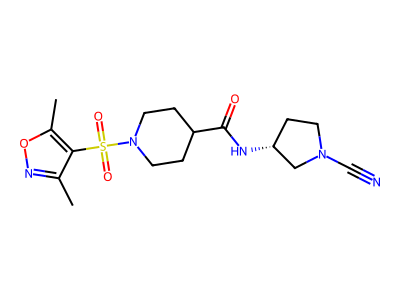
| Target | USP32 |
| Targeted domain | Active site (covalent binding to Cys743) |
| Mode of action | Covalent, fast reversible Inhibitor |
| Control | Huib32NC |
| Recommended cellular usage concentration | 5 µM |
| In vivo use | No |
| Synonyms | BB01CA282 |
| Donated by | Leiden University Medical Center |
| Developed by Leiden University Medical Center in the Framework of: |

|
Probe criteria
| Inhibitor/agonist potency: goal is < 100 nM (IC50, Kd) | Activity assay using Ub-RhoMP: IC50 = 21.2 nM, covalent, fast reversible binding of the active enzyme only; kinact = 0.00062 s-1, KIapp = 50.5 nM, kinact/KI = 12,285 M-1s-1 |
| Selectivity within target family: > 30-fold | No inhibition within the USP family, and no inhibition of other DUBs in gel and proteomics-based ABPP (activity-based protein profiling) experiments in intact cells. 46 DUBs tested in Ub-Rho Fluorescent intensity assay (Ubiquigent) in vitro at 250 nM Huib32: only USP32 and weaker USP6 which has a 97% nucleotide similarity to the catalytic domain of USP32 were inhibited. |
| Selectivity outside target family | 1-step labelling pull-down proteomics experiment in MelJuSo cells (at 1 µM): Off-targets are the biotin-binding proteins, PCCA and MCCC1, and EEF2. |
| On target cell activity for cell-based targets: goal is < 1 µM IC50/EC50 | ABPP assay: inhibition started from 0.1 μM with the maximum inhibition observed at 5-10 μM. EC50 < 0.1μM Inhibition effects: Enhanced substrate ubiquitination, altered endosomal morphology, mimicking USP32 depletion. |
| Control compound (100 times less potent than the probe) | Huib32NC: Activity assay using Ub-RhoMP: IC50 = 6.027 µM |