JNJ-39758979
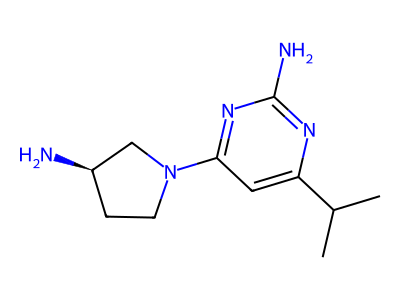
Probe criteria
| Inhibitor/agonist potency: goal is < 100 nM (IC50, Kd) | Surpasses criterion: Human HRH4: Ki = 12.5 nM (Binding assay with membranes from cells transfected with the receptor) |
| Selectivity within target family: > 30-fold | Binding assay: >50-fold selectivity vs. HRH3 (Ki 1023 nM), HRH2 (Ki > 1 µM), HRH1 (Ki > 1 µM) |
| Selectivity outside target family | Kinase panel (66 kinases at 10 µM): cleanCEREP panel (50 targets at 1 µM) with closest off-targets: CHRM1, CHRM2, CHRM3, CHRM4 (Ki > 10 µM) |
| On target cell activity for cell-based targets: goal is < 1 µM IC50/EC50 | Surpasses criterion:Cell-Based cAMP Assay: h HRH4 pA2 = 7.9 (pA2 indicates the conc. of antagonist when double the agonist is required to have the same effect on the receptor as when no antagonist is present); IC50 = 8 nM in mouse bone marrow mast cell (mBMMC) chemotaxis; Active in eosinophil shape change assay (PBMC and WB), mast cell chemotaxis assay, mouse ovalbumin challenge model for asthma |
| Control compound (100 times less potent than the probe) | JNJ-39668551: Human HRH4: Ki > 10 µM, pA2 < 4, HRH3 (Ki > 10 µM) |