T-26c
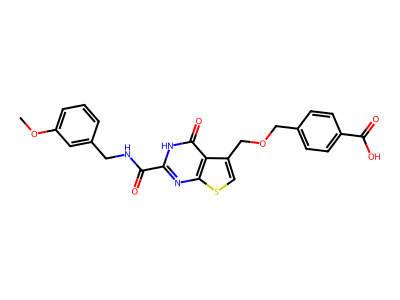
Probe criteria
| Inhibitor/agonist potency: goal is < 100 nM (IC50, Kd) | Surpasses criterion: IC50 = 6.9 pM |
| Selectivity within target family: > 30-fold | Surpasses criterion: > 2600-fold selectivity against MMP13 over other MMPs (MMP1, MMP2, MMP3, MMP7, MMP8, MMP9, MMP10, and MMP14 and ADAM17) |
| Selectivity outside target family | Surpasses criterion: No significant > 50% inhibition or stimulation at 10 μM for 116 biochemical in vitro assays (MDS Pharma: ion channels, receptors, transporters, and enzymes); except rat SRD5A1 (54% inh) & bovine XDH (60% inhibition); Shows off-target activity in the PDSP scan: the closest hit is HRH1C ( Ki= 98 nM) |
| On target cell activity for cell-based targets: goal is < 1 µM IC50/EC50 | Surpasses criterion: Suppresses cartilage degradation in an ex vivo bovine nasal cartilage explant model, IC50 < 100 nM (87% inhibition at 0.1 μM); Cellular cytotoxicity test: 87% of expected ATP content at 0.1 μM |
| Control compound (100 times less potent than the probe) | Surpasses criterion: T-26f is > 5,000-fold less potent on MMP13 (IC50 = 39 nM); Shows off-target activity in the PDSP scan: the closest hits are HRH1 (Ki = 19 nM) and SIGMAR1 (Ki = 263 nM) |