T3-CLK
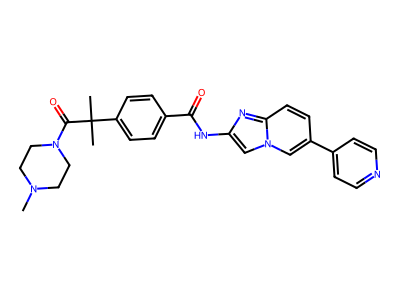
Probe criteria
| Inhibitor/agonist potency: goal is < 100 nM (IC50, Kd) | Surpasses criterion: panCLK probe: CLK1 (IC50 = 0.67 nM), CLK2 (IC50 = 15 nM), CLK3 (IC50 = 110 nM) |
| Selectivity within target family: > 30-fold | Surpasses criterion: 200 to 300 times selective against dual specificity kinases such as DYRK1A (IC50 = 260 nM) and DYRK1B (IC50 = 230 nM) in vitro; NanoBRET assay results: IC50 DYRK1A 32 nM and DYRK1B 67 nMClosest off targets (kinase family, NanoBRET assay): IC50 values: SIK2 (125 nM) and FLT D835V Mutant (138 nM), FLT3 (668 nM), AAK1, MAP3K19, DYRK2, LRRK2, KIT, PDGFRA, PDGFRB, CDK7, SRPK1, MAP3K5 (waiting for new experiment), MAP2K5, LATS2, RIOK2 |
| Selectivity outside target family | Clean PDSP scan except for weak activity on HRH1 (Ki = 2154.79 nM) |
| On target cell activity for cell-based targets: goal is < 1 µM IC50/EC50 | Surpasses criterion:Potent on target activity: CLK1 (Kiapp = 0.7 nM, IC50 = 3.49 nM), CLK2 (Kiapp = 4 nM, IC50 = 16.6 nM) and CLK4 (Kiapp = 0.2 nM, IC50 = 1.98 nM) (NanoBRET results from SGC Frankfurt).; Potent inhibition of endogenous CLK in two different cellular systems. |
| Control compound (100 times less potent than the probe) | Control clean and not activeClosest off-targets in the PDSP scan are TMEM97 (Ki = 411.9 nM), SIGMAR1 (Ki = 798.34 nM), OPRK1 (Ki =990.27 nM) and HTR2C (Ki = 1066.46 nM). |